
Artificial intelligence has fundamentally altered the creative landscape. What once required years of specialized training in fine arts, digital illustration, or photo manipulation can now be initiated with a textual description or a rough concept sketch. Generative AI art has shifted from an experimental technology into a core pipeline component for visual artists, game designers, content marketers, and digital creators.
Understanding how to leverage generative models effectively requires navigating core underlying concepts, mastering prompt engineering, managing style consistency, and selecting the right platforms to execute your vision.
Table of Contents
Fundamentals of Generative AI Art
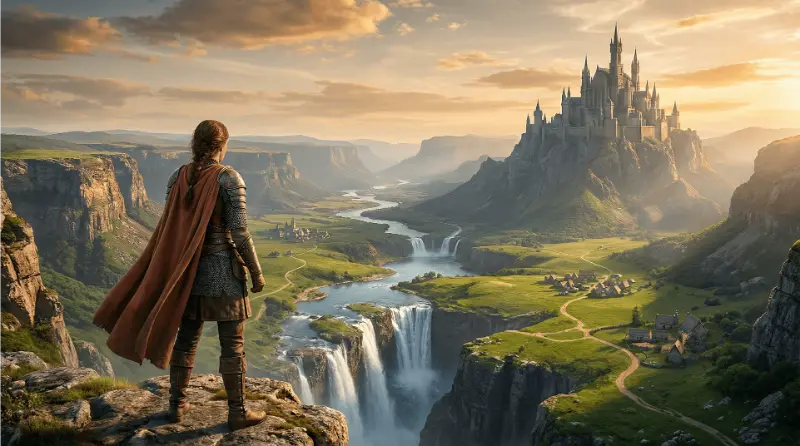
Generative AI art relies on visual models trained on vast datasets of paired images and text. Instead of cutting and pasting existing pictures, these models learn abstract representations of visual elements—ranging from lighting and texture to artistic styles and complex spatial compositions.
Core Architecture: Diffusion vs. GANs
While early AI art systems relied heavily on Generative Adversarial Networks (GANs)—a system where two networks compete to generate realistic outputs—modern visual AI relies primarily on Diffusion Models.
- Diffusion Process: A diffusion model begins with pure digital noise. Through an iterative denoising process, it shapes this noise step-by-step into a coherent image guided by your text prompt or input parameters.
- Text Encoders (CLIP): Text encoders map human language into a high-dimensional mathematical space, allowing the AI model to understand that the word “bioluminescent” translates to glowing, saturated neon blues and greens against dark backgrounds.
Essential Concepts for AI Art Creators
To gain predictable control over your visual outputs, you need to understand several key parameters:
- Prompts & Negative Prompts: The text prompt instructs the model on what to include (subject, lighting, composition, style). The negative prompt tells the model what to exclude (e.g., blur, distorted hands, extra limbs, low resolution).
- Sampling Steps: The number of iterations the model takes to remove noise. Higher values often refine detail, though diminishing returns occur past optimal thresholds (typically 20–50 steps).
- CFG Scale (Classifier-Free Guidance): Controls how strictly the AI adheres to your text prompt. A lower value gives the AI creative freedom, while a higher value forces strict prompt adherence, sometimes at the expense of visual coherence.
- Seed: Every generated image stems from a random mathematical seed number. Locking a seed allows you to keep overall composition constant while adjusting specific prompt parameters.
Masterclass in Prompt Structure and Style Control
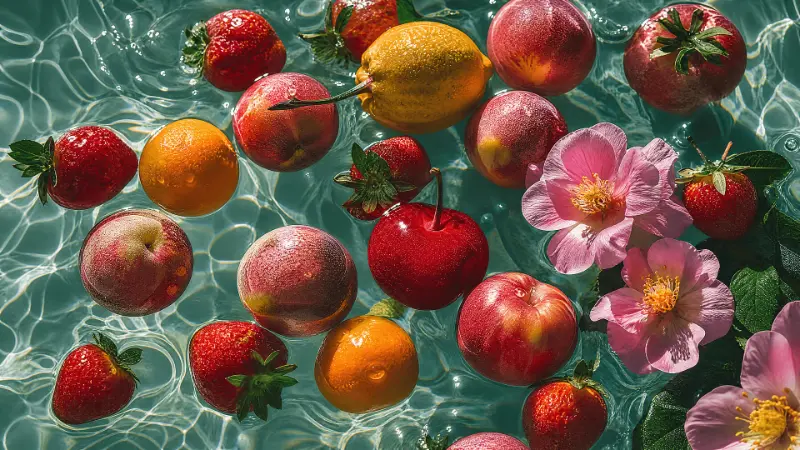
Creating high-impact AI visuals requires structured prompt construction. Randomly throwing adjectives into a prompt box leads to unpredictable, inconsistent outputs.
Building a Structured Prompt Framework
A reliable prompt structure generally follows this hierarchy:
- Core Subject: Clear description of the focal point (e.g., “An ancient mechanical dragon”).
- Environment/Context: Setting, background, and atmospheric elements (e.g., “resting atop a foggy, overgrown mountain peak during twilight”).
- Artistic Style & Medium: Visual style, artistic medium, or rendering technique (e.g., “oil painting on canvas, heavy impasto brushstrokes, dark fantasy concept art”).
- Lighting & Color Palette: Specific light sources and visual tone (e.g., “dramatic side lighting, volumetric rays, palette of deep emerald greens, bronze, and crimson”).
- Camera & Technical Details: Perspective, focal length, or framing (e.g., “cinematic wide angle shot, 35mm lens depth of field”).
Full Combined Prompt Example:
An ancient mechanical dragon resting atop a foggy, overgrown mountain peak during twilight. Dark fantasy concept art, heavy impasto oil painting on textured canvas. Dramatic side lighting with volumetric gold light breaking through heavy clouds, color palette of deep emerald greens, weathered bronze, and muted crimson. Cinematic wide-angle framing, soft depth of field.
Controlling Styles and Art Directions
Instead of relying on generic buzzwords like “photorealistic” or “hyper-detailed,” specify concrete art historical movements, photographic parameters, or rendering techniques:
- Photographic: Specify camera gear, film stock, and lighting (e.g., “shot on 70mm IMAX film, Kodak Portra 400, soft studio lighting, macro lens”).
- Traditional Illustration: Reference materials (e.g., “ink wash illustration, watercolor bleed textures, charcoal pencil line art”).
- Digital & 3D Art: Reference engines and renderers (e.g., “Octane Render, Unreal Engine 5 render, volumetric lighting, subsurface scattering”).
Overcoming Common AI Art Limitations
Despite rapid advancements, standard base models encounter recurring technical limitations. Resolving these issues requires dedicated toolsets and structured workflows.
Common Visual Issues in Raw AI Art:
├── Anatomical Discrepancies (Extra fingers, distorted eyes)
├── Resolution Limits (Pixelation when upscale fails)
├── Style Drift (Inability to keep character faces uniform)
└── Compositional Rigidity (Model ignores complex positional cues)
Character and Asset Consistency
Generating the same character across multiple scenes is one of the hardest challenges in AI creation. Standard text prompts generate random features with every new seed. Solving this requires advanced conditioning frameworks like ControlNet, custom LoRA (Low-Rank Adaptation) training, or specialized image-to-image blending tools.
High-Resolution Upscaling and Detail Preservation
Generative models typically render images at native base resolutions (such as 1024×1024 pixels). Simply stretching these images creates pixelation. Professional creators use Latent Upscaling or AI Detail Enhancement, which adds missing detail and restores sharpness while increasing pixel dimensions.
Precise Compositional Control
Text alone struggles to define spatial placement. Telling an AI to put “a blue sphere on the left and a red cube on the right” often results in mixed colors or swapped positions. Advanced workflows use pose guides, depth maps, and segmentation maps to dictate exact layout structures.
Elevating Your Creation with OpenArt.ai
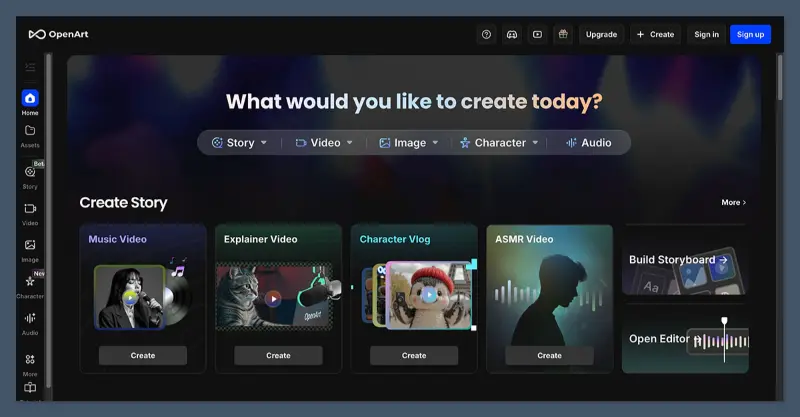
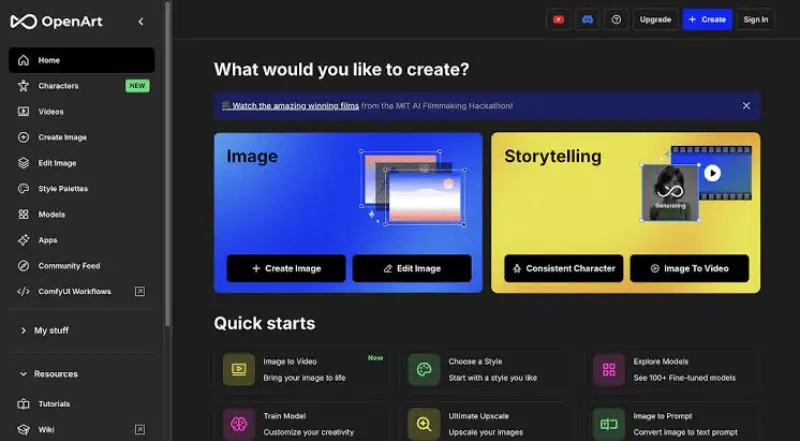
Understanding generative principles is only half the battle; having an intuitive, powerful ecosystem to execute them is what turns concepts into finished work. While many platforms force users into complex visual node graphs or minimalist Discord chat interfaces, OpenArt.ai offers a comprehensive, browser-based creative suite designed specifically for digital artists, designers, and creators.
OpenArt balances raw technical power with accessible design, providing advanced fine-tuning tools alongside an active, collaborative environment.
Core Features That Make OpenArt.ai Stand Out
Multi-Model Ecosystem in One Workspace
Rather than locking you into a single closed model, OpenArt acts as a centralized creative engine. You can seamlessly switch between, combine, and fine-tune multiple state-of-the-art base models within a single project:
- FLUX.1 Models: Access cutting-edge text-to-image capabilities with unparalleled prompt adherence and visual realism.
- Stable Diffusion XL (SDXL) & SD3: Harness open-source flexibility for deep customization, custom styles, and specialized community fine-tunes.
- DALL-E 3 Integration: Leverage high-level conceptual understanding for complex or abstract prompts.
This multi-model access lets you pick the perfect engine for your specific project without maintaining multiple subscriptions or complex local software installations.
Advanced ControlNet & Sketch-to-Image Capabilities
For creators who need exact visual arrangements, OpenArt’s control mechanisms remove the guesswork from image generation:
- Sketch-to-Image: Turn rough hand-drawn sketches or wireframes into fully realized artwork while maintaining your original composition.
- Pose & Depth Control: Import human pose skeletons or 3D depth maps to dictate exact character postures, camera angles, and structural perspectives.
- Canny Edge & Structure Matching: Retain line art boundaries from existing images to redesign assets without losing their underlying architecture.
OpenArt Control Workflow:
[ Rough Sketch / Line Art ] ──► [ OpenArt ControlNet Engine ] ──► [ Style / Prompt Selection ] ──► [ Polished High-Res Render ]
AI Canvas & Inpainting/Outpainting
The OpenArt Infinite Canvas converts visual creation from a single prompt box into an interactive studio space:
- Inpainting (Smart Edit): Highlight specific areas of an image to change details—swap out clothing, fix hand distortions, modify facial expressions, or replace background elements smoothly.
- Outpainting (Expand Canvas): Extend existing imagery beyond its original boundaries to create wide cinematic banners, panoramic backgrounds, or altered aspect ratios without seam lines.
- Object Blending: Layer multiple AI-generated elements onto a single board and blend them into unified compositions with synchronized lighting and shadows.
Custom Model & LoRA Training Made Simple
When standard models do not fit your brand guidelines or unique character designs, OpenArt lets you train custom AI models directly in your browser:
- Train Character Models: Upload 10–20 photos of a subject or character to lock in facial features and key visual attributes across endless new scenes.
- Train Style Models: Feed the system specific art styles, brand color schemes, or visual assets to ensure every output aligns with your target aesthetic.
- Zero Technical Setup: Train powerful custom LoRAs without dealing with GPU configurations, coding scripts, or expensive cloud hardware setups.
Upscaling & Facial Enhancement Tools
Transform raw renders into production-ready assets with specialized post-processing suites:
- Creative Upscaler: Boost resolution up to 4K and 8K while dynamically adding realistic textures, fine details, and line sharpness.
- Face Enhance: Automatically detect facial regions to correct visual artifacts, ensuring photorealistic eyes, skin textures, and natural expressions.
Step-by-Step Guide: Your First Project on OpenArt.ai
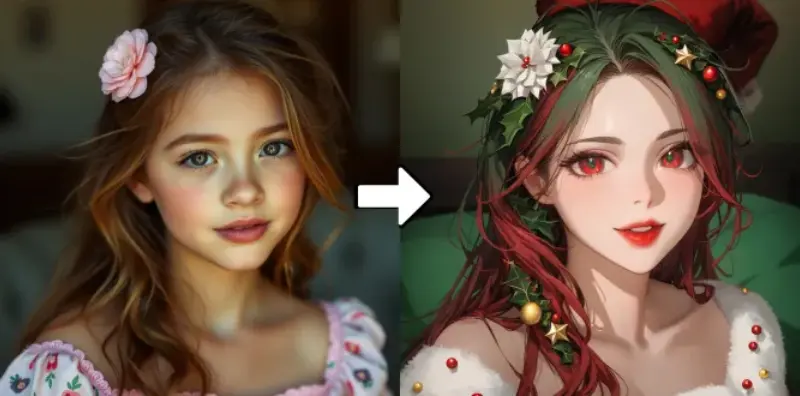
Getting started on OpenArt is designed to be smooth and accessible, regardless of your prior experience with AI art tools.
Step 1: Discover & Benchmark ──► Step 2: Prompt & Model Choice ──► Step 3: Canvas Refinement ──► Step 4: Upscale & Export
Step 1: Discover and Benchmark Styles
Navigate to the Explore tab on OpenArt. Browse millions of user-generated images accompanied by their full generation parameters—including prompts, negative prompts, models used, and seed numbers.
- Tip: Click “Remix” on any artwork that fits your desired aesthetic to load its exact configuration straight into your workspace.
Step 2: Craft Your Prompt and Select Your Engine
Enter your generation workspace:
- Select your preferred base model (e.g., FLUX.1 for realism, SDXL for customized artistic styles).
- Type your structured prompt into the generation bar.
- Adjust your aspect ratio (e.g.,
16:9for cinematic landscape,9:16for mobile stories,1:1for social posts). - Set your generation mode (Fast or Quality).
Step 3: Refine using Canvas and Inpainting
Once your base render is generated, open it inside the OpenArt Canvas:
- Use the brush tool to mark any small imperfections.
- Type a targeted instruction (e.g., “add silver armor details” or “change sky to night with stars”) to modify specific regions instantly.
Step 4: Upscale for Production
When your visual composition is complete, send it to the Creative Upscaler. Increase the scale factor to $2\times$ or $4\times$, adjust the detail enhancement slider, and export a clean, high-resolution visual ready for commercial portfolios, digital printing, or web deployment.
Practical Use Cases for OpenArt.ai
| Industry / Role | Primary Challenge | OpenArt.ai Solution |
| Concept Artists & Animators | Rapid ideation and pose consistency. | Custom character LoRA training combined with Pose ControlNet for uniform character sheets. |
| E-Commerce & Marketers | High photography costs and background swaps. | Inpainting and Background Replacement tools to swap product environments on demand. |
| Game Developers | Generating vast asset libraries and textures. | Sketch-to-Image and Style Training to quickly generate seamless textures and concept environments. |
| Content Creators | Standing out on social platforms with high-volume media. | Fast Multi-Model generation and Infinite Canvas outpainting for multi-platform visual assets. |
The Future of AI Art and Your Creative Workflow
Generative AI is not a replacement for human creativity; it is a high-powered extension of it. The creators who thrive in this evolving environment are those who combine fundamental artistic principles—composition, color theory, storytelling, and visual language—with intuitive, flexible platform tools.
By centralizing multi-model generation, precision control, inpainting, and custom model training into a single coherent interface, OpenArt.ai simplifies complex generative workflows. It removes technical friction so you can focus on visual storytelling and project execution.
Whether you are looking to accelerate your professional pipeline, build consistent character assets, or experiment with visual ideas, explore OpenArt.ai today to transform your creative concepts into high-impact visuals.